Cinematographers Agains George Lucas Using Digital
Replay: Guest correspondent Joe Foster of Shoot HD takes us back to 2002 to relate the making of Star Wars: Attack of the Clones and the digital revolution that infiltrated Hollywood. The year is 2002. The Winter Olympics are being held in Table salt Lake City, Utah. Queen Elizabeth celebrates her Gilded Jubilee. And Michael Jackson's youngest is introduced to the world via a very high balcony. Meanwhile, in Hollywood, a maverick filmmaker shakes the world of cinematography forever. George Walton Lucas, Jr., entrepreneurial filmmaker, creator of Star Wars and Indiana Jones and industrial empire builder, drop-kicked Hollywood into the digital age with the release of Star Wars Episode Ii: Assault of the Clones – the showtime major Hollywood blockbuster to be shot 100% digitally. Though not technically the starting time film to practise and then (that honor goes to 2001's Jackpot), it would notwithstanding shake up the cinematography status quo and divide the manufacture. Although digital cinematography is no longer a unique concept, with all our Alexas, Dragons and Marking Two's at our disposal, back in 2002, Clones encouraged a trend that we take very much for granted – for better or for worse, depending on your point of view. Episode II was shot on Sony's HDW F900 (the 'Panavised' version was known as the F900F). It was a collaborative effort started back in 1997 by Sony and Panavision and would kick-start Sony's CineAlta camera line, resulting in the F55 and F65 in use today. Lucas had planned to film his entire prequel trilogy using this new gadgetry, just it was unfortunately not ready in time. For 1999'due south Star Wars Episode I: The Phantom Menace, George had to brand practise filming his blue and green screens on good sometime-fashioned 35mm Arriflex 435E's and Arriflex 535B'southward (plus a digital Sony HDC-750 for good measure out). In fact, Episode I would be the last Star Wars moving-picture show shot on film until The Force Awakens opens at the cease of this twelvemonth. The F900, unlike other digital cameras at that time, shot footage at 24P in HD when most, including Phantom Menace's HDC-750, would but shoot at 25P or higher up. It was a 2/3 3-CCD EFP camera, which captured 3:1 compressed 1440 x 1080 component video, recording onto cassette. Recording was achieved at a one.78:1 (xvi:9) aspect ratio and would exist cropped, contradistinct and shoved around a ii.35:1 final release widescreen ratio. Unlike Phantom Menace (and 1983'southward Return of the Jedi), it was likewise shot with classic Panavision Primo anamorphic lenses, only equally Lucas did on the first two Star Wars movies. It seemed that even when the world of cinematography was irresolute, some snippets of tradition remained. This try to maintain filmmaking tradition was expanded to the crew and piece of work practices on ready likewise. Fred Meyers (the go-to Hd engineer at ILM) was not only in charge of making sure the new digital workflow ran smoothly, but also worked with Lucas to maintain all the traditional feature picture roles and eliminate any 'civilisation shocks' the crew might experience. Although new roles were added to the mix – a digital camera engineer, someone to maintain the monitoring and recording equipment (DIT anyone?) – the traditional roles were kept the same. There was withal a DP, some assistants, operators, etc. Meyers fifty-fifty kept much of these new roles hidden off-gear up, and then the look and feel of the gear up didn't feel "broadcasty." Whilst keeping an amicable pes firmly in on-set tradition and despite the push towards the eventual digital revolution, Lucas had yet to convince anybody. His efforts to replace traditional film theatre projectors with flashy new digital equipment failed to catch on – at least initially. The primary image was less than 1920x1080 and was recorded with letterbox; this meant that, unfortunately as is the case with digital masters in general, 1440x1080 would remain 1440x1080 until the terminate of time. Of course, there still were (and still are) the celluloid true-blue, with directors such every bit Quentin Tarantino, Steven Spielberg and Christopher Nolan, and cinematographers such as Dan Mindel, Wally Pfister and Janusz Kaminski, arguing the superiority of the motion picture format (dynamic range, particular and set discipline are simply a few examples) and expressing reluctance to cover a digital time to come. On the other side of the battleground, however, are the filmmakers who took a leaf from Lucas'due south large volume of 1'due south and 0's. Cinematographers such every bit Anthony Dod Mantle (who won the first Oscar for Best Cinematography for a digital feature) have migrated to the digital realm. Martin Scorsese, who ironically created The Film Foundation, also made the switch and his 2013 feature The Wolf of Wall Street became the beginning to non produce a 35mm print for cinemas. James Cameron would go on to utilize the Sony CineAlta HDC-F950 for his 2009 3D-fest, Avatar, and remain a digital advocate to this twenty-four hour period. Other examples are the Oscar-winning cinematographer Roger Deakins and New Zealand film behemothic Peter Jackson. Lucas was non the commencement to utilize digital camera technology in films. He was not function of the Danish Dogme 95 movement in the 90's and Episode II was non the first film fabricated digitally. His contribution was to make the Hollywood system take digital seriously. When he boldly abandoned the picture show format, some filmmakers questioned digital'southward advantages over celluloid and its identify in the industry. Other filmmakers saw opportunities the format could achieve and rolled with it. The merits and comparisons to movie will most likely still be debated, even if the film format eventually disappears. Some will prefer one or the other; some volition enjoy the benefits of both. Ultimately, it'due south the work that filmmakers do with the technology at their disposal that's important. Cinematographer Janusz Kaminski sums this up when he one time said, "I think there is more to cinematography than talking about cameras and picture stock. Information technology's like talking to a costume designer nearly what kind of sewing auto they use." Whilst digital revolution has very much arrived, it has non quite conquered the manufacture merely yet. Meanwhile Star Wars: The Force Awakens, shot on 35mm, opens later on this yr…. Graphic past Shutterstock.com 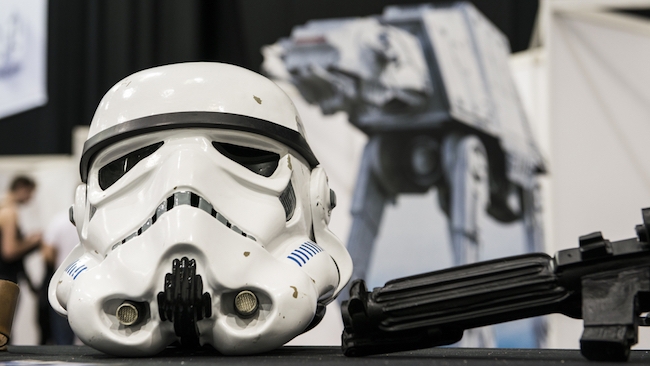
Clones capture
Opposing camps
Digital Pioneer
Tags: Technology

Source: https://www.redsharknews.com/technology-computing/item/2990-how-george-lucas-pioneered-the-use-of-digital-video-in-feature-films-with-the-sony-hdw-f900
0 Response to "Cinematographers Agains George Lucas Using Digital"
Post a Comment